
Knjižnica

Principles of 1KA Public Library Use

1. What are the restrictions on the use of questionnaires in the 1KA Public Library? Can anyone copy and use the whole questionnaire, individual parts or questions?

The questions in the public library are in principle intended for non-commercial use by all registered users of 1KA, but it is advisable to check before use if we have the underlying source, or if there are any specific restrictions on use. As a general rule, if the underlying source does not indicate any specific restrictions, the principle of "Fair use" will apply.

The 1KA website provides the questionnaires and individual questions as examples of good practice and established measurement instruments. For all questionnaires, in line with scientific practice, the sources from which the questionnaires are derived are cited in the foreword. It is also specifically mentioned if the source has any explicit restrictions or copyright protection. If the source of the questionnaire does not explicitly mention any restrictions, the questionnaire may be used for all purposes.

Users are also expected to cite questionnaires or parts of questionnaires taken from a public library appropriately.

For commercial use, rights should be further checked with the original source, which is recommended otherwise as well.

2. What does the Fair Use Principle mean?

The “Fair use” principle allows the use, copying and reproduction of copyrighted works for educational, study or research purposes, except where expressly restricted. In any case, the author and sources must be properly acknowledged.

3. How should users cite the questionnaire that they have obtained from the 1KA public library?

In general, the user is expected to explicitly cite the underlying source so that everyone can identify the author and the location of access to the source. The user may cite the source in the same way as the sources are listed in the 1KA Public Library - whether using the whole questionnaire or just a single question. The Faculty of Social Sciences uses the APA standard for citing sources. However, we also recommend checking with the copyright owner to see if they have specific instructions on how to cite sources.

Example of citing the original 1KA questionnaire:

1KA. 2015. Membership Form. Retrieved from https://www.1ka.si/a/47855 (August 2023).

Example of citing a questionnaire from the Data Archive:

Hafner Fink, Mitja, Brina Malnar, Slavko Kurdija, Samo Uhan and Janez Štebe. Slovenia, Ljubljana: University of Ljubljana, Centre for Public Opinion Research and Mass Communications [production], 2013. Slovenia, Ljubljana: University of Ljubljana, Social Science Data Archive [distribution], 2014. Retrieved from http://www.adp.fdv.uni-lj.si/opisi/sjm13 (August 2023).

Example of citing a questionnaire from a scientific publication:

Diener, Ed, Robert A. Emmons, Randy J. Larsen, & Sharon Griffin. 1985. The Satisfaction with Life Scale. Journal of Personality Assessment 49(1): 71-75.

Example of citing a questionnaire from the web:

Ninamedia. 2015. Vox populi. Retrieved from http://www.ninamedia.si/arhiv.php (August 2023).

4. Is 1KA legally responsible for using questionnaires from another organisation that does not cite or incorrectly cites the sources of the questionnaire?

This is a very complex area from a legal point of view. If another organisation were to submit questions without any copyright information, then most of the liability would have to be shouldered by that other organisation. In any case, the copyright owner of the questionnaire could sue anyone who did not properly cite their copyright work.

It should also be pointed out that the legal treatment of intellectual property varies from country to country. The intellectual property regime of the measurement instruments themselves and the results they produce is also unclear. We therefore advise that whenever you are in a dilemma about the use of a foreign work, you should check with the copyright owner about the use.
Related content


Using Library When Creating a Survey

In the Library tab - 'Public library' (link is only accessible to registered users in 1KA), you can view pre-made type and content questionnaires. As part of the standard questionnaires, you will find surveys, forms, quizzes and conditions and filters. You can copy these questionnaires and customize them to your survey. When editing the questionnaire, it is possible to use the library of already created surveys and questions to copy the standard questions and questions from the survey previews to your survey. You can also add your own questions and surveys to the library and reuse them.

1. Using the library to copy surveys

To copy the prepared questionnaires, in the 'Public Library', click on the 'plus' before the folder name to open the desired folder and click 'Copy survey' to the right of the survey name. Next to this option, there is also the option 'Preview', where you can see the entire questionnaire (magnifying glass icon). Once you copy the survey, you can customize it to your needs.

The 'My Library' tab allows you to store your surveys in it, giving you a better overview of them. In the same way, as in the Public Library, you can copy surveys that you have added to My Library. The procedure for adding surveys is described in the last paragraph.

2. Copying questions from pre-made surveys into your own survey

In the 'EDIT' - 'Questionnaire' tab, the 'Library' tab is located at the top right, accessed by clicking on the blue book icon.

  • to copy questions in the 'Type of questions' sub-tab, first click on the plus next to the folder name to open the desired folder and then click on the name of the question you want to copy to your survey (if you just hover the mouse over the question without clicking it, you will be shown the content of the question). A copied question will appear at the end of your survey.
  • Similarly, you can first find the desired survey in the 'Surveys' sub-tab. By clicking on the plus, all the names of the questions in this survey are visible. Here, too, you simply copy the questions by clicking on the selected question of the existing survey.

3. Add your own questions and surveys to the library

You can also add your own questions from your surveys and your own surveys to the library. In the 'Type of questions' and 'Surveys' tabs when editing the questionnaire, you will see two folders (My Questions and My Surveys) from which you can copy the questions in the same way as described in paragraph 2. You can also add your own folders and rename them.

  • To add questions to the library, select the survey in the 'My surveys' tab where the question you want to add to the library is located. Then open the Library - blue icon on the top right in the form of a book and find the question you want in your survey. After that, click on the question toolbar, hold down the mouse button and transfer the question to the My Questions folder by dropping it in the name of your folder.
  • To add surveys you have created to your library, find the selected survey in the 'My surveys' tab and click on the arrow icon - 'Add survey to my library' on the far right of the survey name. These surveys then appear in the 'My Library' tab and in the tab 'Library' - 'Surveys' when editing the questionnaire, from where you can copy any questions from this survey to a new survey. You can also do that in the 'EDIT' - 'Settings' - 'Basic info' - 'Library'  tab, where you select the option 'My surveys'.


Related content


Granting Survey Access to 1KA Helpdesk

Protecting user data is one of 1KA's top priorities. Access to data is limited to the author (editor) of the survey and additional co-editors, which are added by the author of the survey.

1KA's helpdesk and the website administrator of www.1KA.si do not have access to surveys and data without the explicit consent of the user.

In case the user requires assistance from 1KA’s administrators, the user must grant temporary access to 1KA's helpdesk (until the issue is resolved). Despite granted access, administrators are still committed to the highest standards of privacy protection, as defined in the Terms of Use.

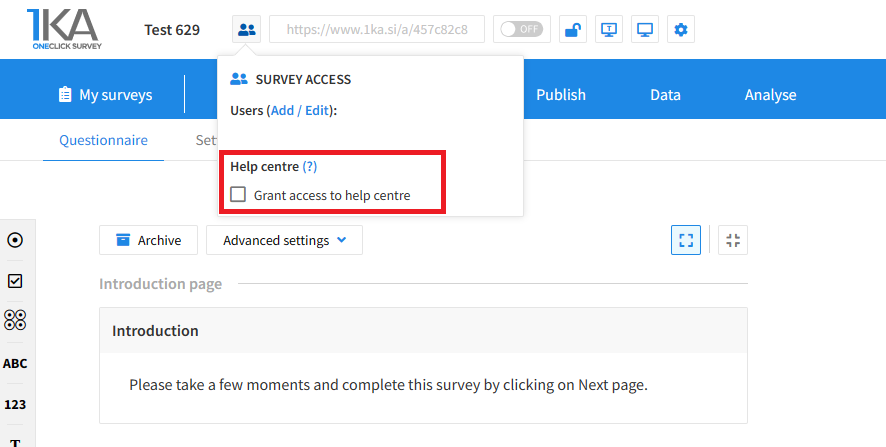
Each survey has an icon in the top left corner which enables you to grant access to 1KA's helpdesk and administrators. You have to click 'Grant access to help centre'.

Grant access to help centre
 

The author can add co-editors in the tab 'EDIT' – 'Settings' – 'Editor access'.

Related content

1KA is free to use for basic users